Monthly Archives: February 2011

Two different methods of gathering razor clams

The following post was kindly sent to us by Woodlore customer Emma Wennersten:

Dear all at Woodlore,

I watched recently on the Discovery channel one of your Wild Foods shows, where you and the good Professor gathered food from the ocean (including sea buckthorn and seldom have I seen such unappetising goo…).

Anyway, when you got to the razor clams I was surprised to see you use salt to get them out. My boyfriend has been taking me to gather razor clams for years here in the west of Ireland and I didn’t even know you could use salt. What he does (and I, but I suck at it to be quite frank) is take a sharpish knife with a long blade (a breadknife is good) and walk very slowly up to the breathing hole that indicates that there is a razor clam.

You then slide the knife, not point first but rather the whole sharp side in and downwards towards where the clam should be. Start a good 2-3 inches away from the hole at least. You will feel the edge catching the clam shell, then all you have to do is dig it up – your knife pressing against it stops it from digging its way to freedom.

I am only writing this because at the time of that program at least, Ray stated that he wasn’t sure how our ancestors would have caught the razor clams. He may well have found out by now but this is the way we do it!

Emma Wennersten

You can see Ray’s method of gathering razor clams in the following video clip, taken from the BBC DVD Ray Mears Wild Food:

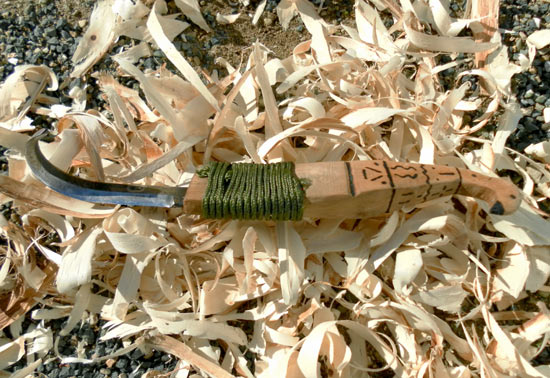
Rogelio Lora’s hand-finished Large Crooked Knife

Woodlore customer Rogelio of Spain contacted us recently to let us know how he got on with his Large Crooked Knife Blade:

Rogelio Lora's Large Crooked Knife

Rogelio’s finished Large Crooked Knife (click for full size)

Hello Woodloreans,

My crooked knife blade (Christmas present) finally arrived and I couldn’t wait to put the handle on to it. I went into the woods with only my laplander saw and my mora knife, as I didnt have my axe here.

I found a piece of olive wood, which is an extremely hard wood, that I had used half a year ago to carve a spoon. I cut it into size, removed the rotten outside and started carving; all of this I did without yet having the blade with me.

As woods here in southern Spain tend to be harder, I thought the thumb support would be essential, and as I was carving it I realised that it was starting to look like a bird’s head, so I decided to fashion it in this way.

The engravings I did with a lense, something I had tried before on a walking stick, and I thought I’d finish it with some olive oil, rather than other more appropriate oils for woods, as it was the natural oil that this wood would originally contain: it was a success.

I would recommend anyone thinking about buying a crooked knife to give it a try; the handle was actually easier to make than I first thought, I mean it fits in surprisingly well. There’s also a video at YouTube called “making a crook knife” (parts 3 and 4 are about the handle) which really helped.

Anyway, I’m really happy about this tool, even though at the beginning I thought maybe 80 euros would be too much for a blade, I already gave it a try and it is a superb piece of kit.

Kind regards,

Rogelio L. Lora