Category Archives: Bushcraft Tips & Guides

Bushcraft Guides & Tips

Get Prepared For Another Frosty Winter

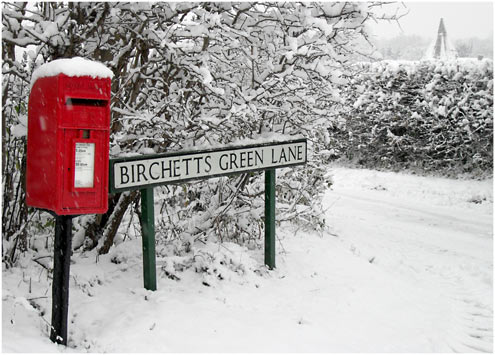
2011 has provided us with some odd weather here in the UK, with dry, mild days continuing all the way into December. However, anyone getting up early for work this past week could tell you that the cold weather is definitely creeping in – icy windscreens, gritters on the roads, and the sight of a postman in trousers instead of shorts are all tell-tale signs!

Recommended kit and clothing for winter

Ray Mears and the Woodlore Team have hand-picked a list of Recommended Kit and Clothing for Winter, to help keep you safe and warm this festive season. With the last few years bringing a healthy dusting of snow across the land (often followed by abandoned cars, closed shops and twisted ankles galore), now is a better time than any to get yourself prepared.

So don’t let the weather get the better of you – get out there and make the most of it.

How to make your own Hammock – Part 4

<< Read Part 3 <<


Part 4:


Tightening the hammock:

On the other side, do the same, but without the two outer tension ropes. After you take the two ropes through the first bar, weave them through the edge meshes of the hammock and insert them through the second bar. Hang your hammock between two fixed points now and go in it. Make sure you distribute your weight as evenly as possible when you first enter the hammock. Before entering, it is wise to check the hammock if the mesh and mazes are even, and adjust them when necessary. When I worked with paracord I found that the knots were able to slide and move because of the slipperiness of the cord.

The hammock will now stretch out. Depending on the material you have chosen you will probably have to repeat it a couple of times. I use a Timber Hitch on one end and a Waggoner’s Hitch on the other. This last knot is described in Ray’s Essential Bushcraft book on page 168, and is ideal to put some tension to your hammock. Tighten the hammock again and again and put your full weight on your project until you feel the hammock is not getting any longer.

At this time be careful not to fall out of your hammock because the outer tension ropes are not in use at this time. When they are in use these ropes will greatly improve your ability to stay in your hammock. When you think your hammock has been stretched enough it is time to put the outer tensioning ropes to work. Connect the loose ends of those outer tensioning ropes with each other with a simple Reef Knot.    

By tightening or loosening those outer ropes you are able to switch between different models of your hammock.  Tightening those ropes will result in a model consisting of a bathtub, while loosening those ropes will result in a hammock like an ironing board. Now, check the rest of your hammock and remove any pieces of rope which are too long.


The finished Hammock:

Figure 14 - The Finished Hammock

Figure 14 - The Finished Hammock


Woodlore would like to thank John van Zanen for all of his hard work in putting this extensive guide together. You can expect more from this contributor in the future…

To everyone out there who has used this guide to make your own hammock, please let us know how you got on, and send us a photo to show where your hammock ended up!

How to make your own Hammock – Part 3

<< Read Part 2 <<


Part 3:


Now that you have finished the hard work of making all those knots, you are ready for the finishing and final constructing of your hammock. At this time you will probably be able to make a Sheet Bend knot blindfolded. I have several hammocks knotted using sisal rope, but sisal really is murder on your hands. In the past I have worked with sisal until my hands were sore and blistering. So it was about time to try to make a hammock of green paracord. This makes life more easier. There is always a great sense of relief when you finally finish the net of the hammock. A milestone so to speak.

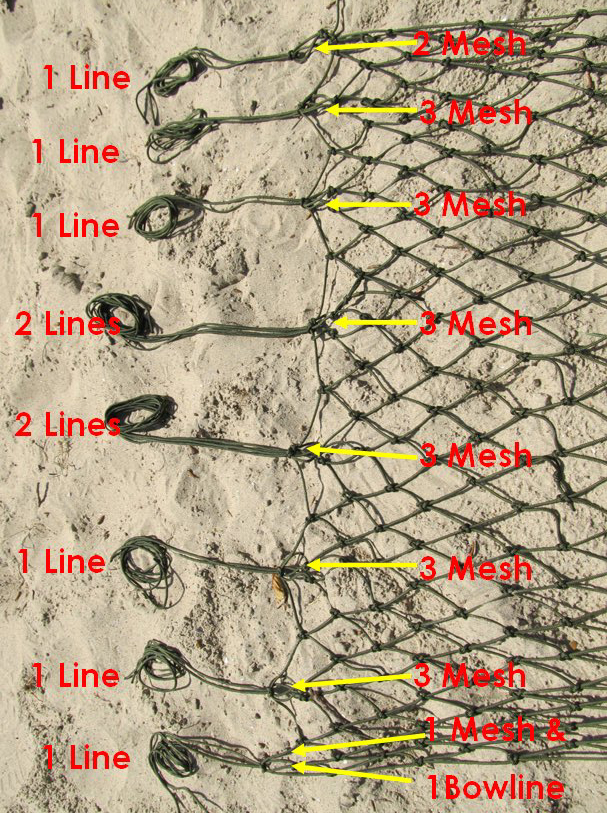
Now, cut 20 pieces of rope of 220 centimetres; these ropes you will be doubled and will be attached to the ends of the mesh of your hammock, acting as guy wires. Use two double wires for the middle two guy wires. This is because most of the force will be put to those wires. Figure 8 shows the mesh you need to take to attach the wires to.

Figure 8 - Lines & Mesh

Figure 8 – Lines & Mesh

Continue reading

How to make your own Hammock – Part 2

<< Read Part 1 <<


Part 2:


Make a small Bowline Knot in the first piece of rope and put the loop around the nail in cross B. Zigzag the rope loosely around the nails of the first and second row. When you reach the last nail in the first row, put the rope around the last nail in the third row and turn to the last nail of the second row to make your first knot (see Figure 3A & 3B).

Figure 3A - The Start

Figure 3A - The Start


Figure 3B - The First Knot

Figure 3B - The First Knot

Continue reading

How to make your own Hammock – Part 1

Over the coming weeks, we will be releasing a four-part guide on how to make your very own hammock using para cord. This excellent step-by-step tutorial was very kindly supplied by Woodlorean John van Zanen of the Netherlands; thank you!

We’ve split the guide into four different sections, allowing you to have a go at each stage before the next set of instructions is released. Today we have Part 1; we hope you enjoy this guide and would love to hear from anyone that gives it a go.


Part 1:

It is always very rewarding to make your own kit. When I finished the Camp Craft course at Woodlore I decided to make a hammock. I learnt making a hammock using this technique when I was a boy scout and it was quite a long time ago since I had made my last one. But when you are living in a fixed camp a hammock is a useful item. It not only gives you a place to sleep at night but also a place to sit during the day and it adds comfort to the times you spend outdoors.

This is an easy technique and you don’t have to be a knots expert to try to make this sort of hammock. So during the construction of my latest project this summer I took some pictures while I was working and translated the instructions they gave me as a boy scout into English. I hope this guide will inspire my fellow Woodloreans to make their own project. Good luck.


What do you need?

  • Sisal rope, two wire, about 1 kilo (when using paracord you will need about 230 meters depending on the length of the hammock)
  • Two pieces of wood from 2.6 cm by 1.8 cm by 70 cm long (or just two pieces of wood from nature)
  • Two steel rings (optional)
  • A shelf or board of about 24 to 110 cm
  • Sixty-six nails of 6.5 cm
  • Stick or broomstick of about 120 cm
  • Tape


Preparing your work board:

Draw the pattern in figure 1 on the shelf and hit the nails into the board at the spots marked with the dots. Remove the heads from the nails with a pair of pliers. Also, drive a nail in the board at the site of cross B. The nails have to stick about 4 cm out of the board. Be careful for nails that protrude below the shelf! Treat the top of the nails with a file and sandpaper and remove the sharp edges to save your hands and your rope.


Figure 1A - The Pattern

Figure 1A – The Pattern

Continue reading

How to make your own meth burner from a tin can

Rogelio, a fellow Woodlorean from Spain, e-mailed us previously with some pictures of his hand-made crooked knife handle, which we posted on our blog. Recently, he got in touch with us again, this time with an excellent article on how to make a DIY meth-burning stove from just a tin can. We’ve posted the full guide below, complete with step-by-step pictures, for you all to see. Thanks Rogelio!

Hello Woodloreans,

I have just returned from a friend’s house with whom I have been making my own meth alcohol burner to fit in my pocket stove from tin cans, and after seeing how well it actually works, I thought it would be nice to share with you some pictures on its making.

To start with, you need the bottom ends from two tin cans and a rectangular strip that will fit into them (this must be cut slightly higher than the other pieces, you’ll see why later). If you use cans made from stainless metals it’ll last longer.

Step 1

Step 1

Continue reading

Protecting against and removing ticks

2011 has been a particularly bad year for ticks all over the UK.  They can be active all year round in long grass, bracken, heather, woodland and hedgerows, especially where deer and livestock are present.  Ticks can carry organisms which may cause Lyme disease, so it is very important to keep an eye out for them.

Tick saliva contains various bio-chemicals that act as anaesthetics (which numb the bite area), anti-inflammatories (which prevent swelling), anticoagulants (which stop the blood from clotting), and cement to hold the tick firmly in place. They can feed for up to seven days without causing irritation. The barbs on the tick’s hypostome also keep the tick anchored in place while it feeds. It is during the introduction of saliva, and any regurgitation that may occur during the feeding, that infectious organisms can enter the body of the host, causing disease.
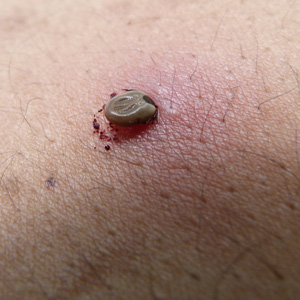
A tick found on one of our instructors

A tick found on one of our instructors

It is therefore important to prevent ticks feeding from us. To do this, we recommend that you wear gaiters or long trousers tucked into your socks when walking in long grass. To deter ticks, it’s a good idea to use insect repellent, such as Mosi-guard or Ultrathon, and to check yourself regularly.  As the old saying goes – prevention is better than cure!

If, when checking yourself you find a tick, it is best to act quickly.  The tick needs to be removed with either a pair of tweezers or a tick removing tool. Be careful not to squeeze the body, and aim to remove the tick whole.  It is best to wipe the area afterwards with antisceptic wipes.  If you experience any symptoms of Lyme disease, seek further advice and treatment from your doctor.

We have contacted our friends at BADA-UK (borreliosis & associated diseases awareness UK), a charity who spread the word about ticks and tick-borne diseases in the UK and Ireland.  Ray Mears became their patron a couple of years ago after he was diagnosed with Lyme disease, to help spread awareness.  We have received from BADA-UK up-to-date information to provide to our clients on courses they attend with us, as well as some fantastic tick removing tools, which are available to buy from BADA-UK.

Crusader Cup hanger modifications

Woodlore customer Paul Savoie kindly sent in the following article and photos:

Dear Woodlore,

Over the past two years I have purchased most of Ray’s DVDs from a local Canadian supplier; I noted that Ray always seems to have his NATO Crusader Cup with him. Shown below are a few photos illustrating some of the modifications I have made to the BCB Crusader Kit. I found the “clip-on” BCB Crusader Cup Hanger to be a rather precarious arrangement and an accident waiting to happen when handling boiling water over an open fire.

I made a new hanger using 3 mm (1/8 inch) diameter 304 grade stainless steel wire with corresponding modifications to the Crusader Cup and lid. The notches on the cup’s rim/lip keeps the wire hanger upright and very secure (see photos below):

Paul's custom-made wire cup hanger
Paul’s custom-made wire cup hanger

Continue reading

Gumnut Fire Stick Handles

Richard Spencer, a Woodlore customer from Australia, kindly sent in the following post:

Dear Woodlore Team,

Having received the Fire Stick Rods from you, I had a bit of fun making handles for them:

Richard Spencer's Fire Stick

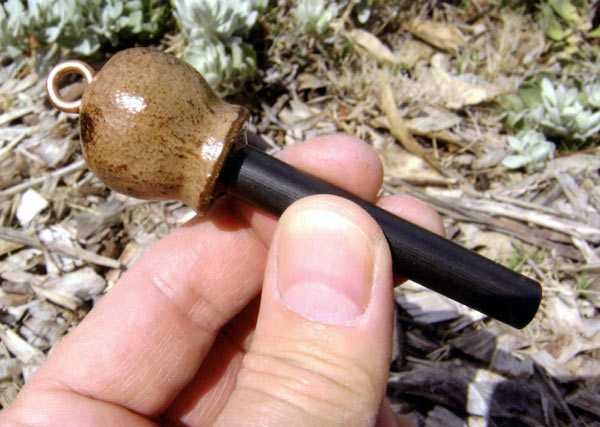
Richard Spencer's Fire Stick, complete with gumnut handle

I used spent gumnuts. These things lie in their countless millions on the ground, in the woods and on the side of the roads where the gumnut trees grow. You’ve probably heard of them. They’re light, they float and they’re very tough yet easy to work with few tools. I used one tiny flat file and a bit of sandpaper to make this handle. There’s a small brass picture hook for a lanyard.

The gumnuts contain seeds which drop out, leaving these tough, smooth shells, which just beg to be used for other things.

They can be stuffed with cotton wool and after a few drops of aromatic oil, they’ll keep the car smelling fresh. If you soak them in paraffin then fill them up with melted candle wax, they make great firelighters.

Yours sincerely,

Richard Spencer

Two different methods of gathering razor clams

The following post was kindly sent to us by Woodlore customer Emma Wennersten:

Dear all at Woodlore,

I watched recently on the Discovery channel one of your Wild Foods shows, where you and the good Professor gathered food from the ocean (including sea buckthorn and seldom have I seen such unappetising goo…).

Anyway, when you got to the razor clams I was surprised to see you use salt to get them out. My boyfriend has been taking me to gather razor clams for years here in the west of Ireland and I didn’t even know you could use salt. What he does (and I, but I suck at it to be quite frank) is take a sharpish knife with a long blade (a breadknife is good) and walk very slowly up to the breathing hole that indicates that there is a razor clam.

You then slide the knife, not point first but rather the whole sharp side in and downwards towards where the clam should be. Start a good 2-3 inches away from the hole at least. You will feel the edge catching the clam shell, then all you have to do is dig it up – your knife pressing against it stops it from digging its way to freedom.

I am only writing this because at the time of that program at least, Ray stated that he wasn’t sure how our ancestors would have caught the razor clams. He may well have found out by now but this is the way we do it!

Emma Wennersten

You can see Ray’s method of gathering razor clams in the following video clip, taken from the BBC DVD Ray Mears Wild Food: