Category Archives: Bushcraft Tips & Guides

Bushcraft Guides & Tips

How to fit a new axe handle

The following guide was very kindly provided by Woodlore customer and Camp Craft course attendee Martin Dryden:

Hi Woodlore,

Just wanted to drop you a line to say thanks again for sorting out the Wildlife Hatchet Axe Head for me. It took a little while to source some suitable Ash and to shape the handle, but below are some pictures. The axe head is a really high-quality item and was a pleasure to work with.

My Small Forest Axe (issued on the Camp Craft Course) made light work of the job of splitting the Ash log I had. The wedge is the Holly Glut I made on the course also, so it’s now served use again.

Fitting a new axe handle

Fitting a new axe handle

Continue reading

What Knots does Ray Mears use to Pitch his Tarp?

We’re often asked by customers about the Tarp Taut Hitch and other quick-release knots that Ray Mears and the Woodlore team use when pitching our tarps/hootchies; hopefully this post will help.

The knots which Ray uses to pitch his tarp are demonstrated in the following video clip:

The pitching of tarps using these knots is taught on a number of our Bushcraft Courses, including:

The Hand Forged Knife Blade – a guide to making your handle

The following article was kindly written by Woodlore customer Martin Dryden. Not only is it a great review of the Hand Forged Knife Blade, it also serves well as a guide for those thinking of having a go at making their own knife handle:

Martin's finished knife

Martin's finished knife

I’ve looked at the Woodlore knife for many years and loved the craftsmanship that’s gone into it. I also saw the episode of Ray in Julius Pettersson‘s forge, while he was making a knife. When I saw the Hand Forged Knife Blade listed on Woodlore’s shop I wanted the chance to make my own knife to try out some skills and hopefully do justice to it. I’d had a go with a knife kit before and this was very rewarding but I knew I could do better.

Continue reading

How to make your own tracking markers

The following post was very kindly sent to us by Woodlore customer John van Zanen:

Hi Ray and Woodlore Team,

After doing the Woodlore Tracking course this year I am keen on getting better and better at tracking. I bought one of the books that Jeremy recommended and can’t stop reading about the subject. This Tuesday I had a ‘father and son day’ and when I asked my son what he would like to do he said, “Let’s do some pace tracking.”

So, with only Monday to prepare, I had to come up with some markers for our pace tracking exercise. I went with my son and daughter to the chemists and bought 46 wooden tongue spatulas (the thing a doctor puts into your mouth when you have to say “Aah”) for the price of 2 Euro’s.

Then it was time to visit another chemist shop to buy some paint to colour the spatulas. I bought two tins of Dylon paint which is normally used for dyeing clothes. I used scarlet red (nr. 32) for the red markers and fluorescent green (nr.64) for the green ones (5 Euro’s for both tins).

At home me and my kids soaked the spatulas in the paint for about 10 minutes and after soaking we rinsed the spatulas to get rid of the redundant paint. For drying the spatulas we used a hair dryer. The kids could do all this themselves and were enjoying making their own kit. The wooden spatulas absorbed the paint quite nicely and it beats having to paint them one by one.

After drying the spatulas we rolled a water based no-colour finish on them so we would not end up with green and red hands after an hour of pace tracking. This really made a nice finish to our home made markers. They look great we think.

I’ve included a picture so you can see the result of our work. It might just be a good tip for anyone who has done the Woodlore Tracking course and wants to make some markers of their own. My son and his friend had a great time pace tracking yesterday.

John van Zanen, The Netherlands
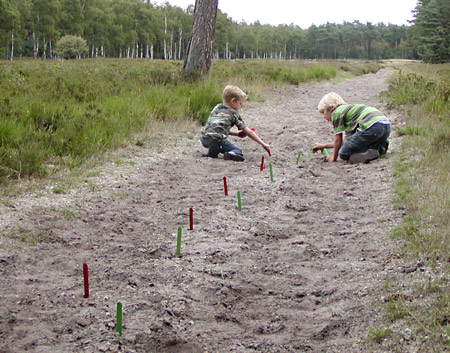
Tracking markers

John’s son and his friend with their home-made markers

Ray Mears: How to track wildlife

BBC Wildlife Magazine

BBC Wildlife Magazine online

How do you become at one with the landscape and follow the animals that live there? Well, BBC Wildlife Magazine spent a day in the woods with Ray Mears and asked that exact question.

You can now read the full interview with Ray online, complete with useful tracking insights and stories from his past adventures, from the following link:

Ray Mears: How to track wildlife

If you’re interested in learning about tracking and giving it a go yourself, why not take a look at our Woodlore Tracking course, or the Animal Tracks & Signs guide book.

Choosing and using an axe

Over the years, Woodlore have come to stock a wide range of Gransfors Axes, so we appreciate that it may be tricky picking the right one for the job.

The following video – taken from the DVD extras of Ray Mears, Bushcraft Survival – Series 2  – covers the various benefits and primary uses of Gransfors’ three most popular axes (from smallest to largest):

We also stock a wide range of Gransfors Splitting Axes in our shop; if you’d like any advice on these models just give us a call and we’ll be happy to help.

Also, the use of axes is covered on our Camp Craft course.