Butterfly identification competition

During the second half of summer back in 2010, Woodlore Field Staff member Sarah Day took some fantastic photos of a butterfly that she had spotted. The first person who can correctly identify the species will win a £10.00 Woodlore Voucher, which can be used against any items of kit in our Online Shop or against a Bushcraft Course of your choice. Good luck!

The butterfly, correctly identified as a Male Common Blue (Polyommatus icarus)

The butterfly, correctly identified as a Male Common Blue (Polyommatus icarus)

Continue reading

Nick Davis’ Julius Pettersson Knife

Woodlore customer Nick Davis had a go at fitting a handle to his Julius Pettersson Knife Blade, and sent in the results:

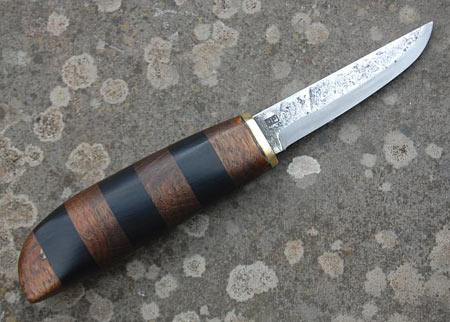
Nick Davis' Julius Pettersson Knife

Nick Davis' finished Julius Pettersson Knife

Hi Woodlore Team,

Just wanted to send in a photo of my finished Julius Pettersson knife in the hope that you will add it to the others already on your blog page.
 
The handle is Thoya Burr and buffalo horn inlayed with bone. The ferrule and tang are both brass for added strength.
 
Working on these wonderful blades is such a relaxing and rewarding undertaking as you are building something that will be a source of pride every time you use it… and it will last a lifetime!
 
Many thanks for all you do in sourcing quality items such as these blades!….. now I better get on with building my crooked knife!
 
All the Best,
 
Nick Davis

A reworking of the Julius Pettersson knife blade

The following text and accompanying photographs were kindly sent in by Woodlore customer Jon Mac:

Dear Woodlore,

Allow me to introduce myself. My name is Jon Mac, I am a spoon carver working in Devon. A few years ago I was given a Julius Pettersson laminated blade to assist me in my work. The blade has excellent quality and performance.

After fitting the blade into the handle which I designed and made, I sent the blade to a knifemaker, Chris Grant, to be slightly reshaped to my specifications. The Pettersson blade was tweaked to my preferences, these being, a narrower belly and finer point to facilitate an ease in carving internal radii.

The handle was designed very much with carving in mind – specific ergonomics for everyday, comfortable and accurate use.

Chris and I wanted to thank you for providing the spark that became this exciting and rewarding project. This has helped me find the working knife that I have been searching for, for many years.

Jon Mac

Before

Jon’s Julius Pettersson Hand-forged Knife Blade before being reshaped

Continue reading

Two different methods of gathering razor clams

The following post was kindly sent to us by Woodlore customer Emma Wennersten:

Dear all at Woodlore,

I watched recently on the Discovery channel one of your Wild Foods shows, where you and the good Professor gathered food from the ocean (including sea buckthorn and seldom have I seen such unappetising goo…).

Anyway, when you got to the razor clams I was surprised to see you use salt to get them out. My boyfriend has been taking me to gather razor clams for years here in the west of Ireland and I didn’t even know you could use salt. What he does (and I, but I suck at it to be quite frank) is take a sharpish knife with a long blade (a breadknife is good) and walk very slowly up to the breathing hole that indicates that there is a razor clam.

You then slide the knife, not point first but rather the whole sharp side in and downwards towards where the clam should be. Start a good 2-3 inches away from the hole at least. You will feel the edge catching the clam shell, then all you have to do is dig it up – your knife pressing against it stops it from digging its way to freedom.

I am only writing this because at the time of that program at least, Ray stated that he wasn’t sure how our ancestors would have caught the razor clams. He may well have found out by now but this is the way we do it!

Emma Wennersten

You can see Ray’s method of gathering razor clams in the following video clip, taken from the BBC DVD Ray Mears Wild Food:

Rogelio Lora’s hand-finished Large Crooked Knife

Woodlore customer Rogelio of Spain contacted us recently to let us know how he got on with his Large Crooked Knife Blade:
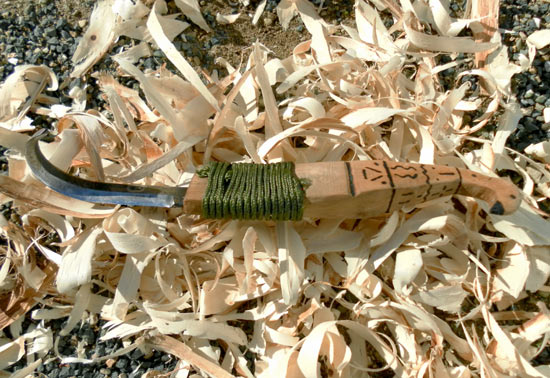
Rogelio Lora's Large Crooked Knife

Rogelio’s finished Large Crooked Knife (click for full size)

Hello Woodloreans,

My crooked knife blade (Christmas present) finally arrived and I couldn’t wait to put the handle on to it. I went into the woods with only my laplander saw and my mora knife, as I didnt have my axe here.

I found a piece of olive wood, which is an extremely hard wood, that I had used half a year ago to carve a spoon. I cut it into size, removed the rotten outside and started carving; all of this I did without yet having the blade with me.

As woods here in southern Spain tend to be harder, I thought the thumb support would be essential, and as I was carving it I realised that it was starting to look like a bird’s head, so I decided to fashion it in this way.

The engravings I did with a lense, something I had tried before on a walking stick, and I thought I’d finish it with some olive oil, rather than other more appropriate oils for woods, as it was the natural oil that this wood would originally contain: it was a success.

I would recommend anyone thinking about buying a crooked knife to give it a try; the handle was actually easier to make than I first thought, I mean it fits in surprisingly well. There’s also a video at YouTube called “making a crook knife” (parts 3 and 4 are about the handle) which really helped.

Anyway, I’m really happy about this tool, even though at the beginning I thought maybe 80 euros would be too much for a blade, I already gave it a try and it is a superb piece of kit.

Kind regards,

Rogelio L. Lora

How to fit a new axe handle

The following guide was very kindly provided by Woodlore customer and Camp Craft course attendee Martin Dryden:

Hi Woodlore,

Just wanted to drop you a line to say thanks again for sorting out the Wildlife Hatchet Axe Head for me. It took a little while to source some suitable Ash and to shape the handle, but below are some pictures. The axe head is a really high-quality item and was a pleasure to work with.

My Small Forest Axe (issued on the Camp Craft Course) made light work of the job of splitting the Ash log I had. The wedge is the Holly Glut I made on the course also, so it’s now served use again.

Fitting a new axe handle

Fitting a new axe handle

Continue reading

Another animal track ID competition

As with our last competition, the picture below shows an animal track which was photographed by Woodlore office member Steve, on a trip to East Africa. As always, the first person to correctly identify it wins a £10.00 Woodlore Voucher – good luck!

Animal print

The animal print found in East Africa, correctly identified as that of a baboon

It seems like this print threw a lot of you, and some of us as well! However, it was correctly identified by Jamie as the print of a baboon – well done Jamie.

If you’d like to brush up on your skills at tracking and identifying wildlife, we recommend taking part in the Woodlore Tracking course, or, alternatively, taking a look at the Animal Tracks & Signs book.

Chris Waugh’s hand finished Large Crooked Knife Blade

The following article was kindly sent in by Woodlore customer Chris Waugh, and features the S. Djarv Hantverk Large Crooked Knife Blade, which is currently on special offer at £45.00 while stocks last:

Dear Ray and all at Woodlore,

I purchased the Large Crooked Knife Blade (Right Handed) not too long ago from you all, and I just wanted to send you my pictures of the finished knife! I used a beautiful piece of South American Cocobolo wood to make my handle:

The handle before being fitted and finished

The handle before being fitted and finished

Continue reading

Ray Mears to give two talks at The London Outdoors Show

The Outdoors Show at the ExCel Centre, London

On Saturday January 15th, Ray Mears will be appearing at the London Outdoors Show at the ExCel Centre, where he will be giving two talks, each followed by a private book signing session.

Alongside a lineup of outdoors experts, adventurers and celebrities – including Sir Ranulph Fiennes, Ben Fogle and Simon King – Ray will be appearing as part of this years ‘Outdoor Heroes Theatre’. These exclusive theatre sessions will be hosted in the ExCeL’s platinum suite, a fully self-contained and separate auditorium.

Ray will be giving an hour-long talk, followed by a Q&A session and the aforementioned book signing, at 11 AM and 3 PM this Saturday. For more information or to book your ticket, please visit the following link:

The London Outdoors Show – Outdoor Heroes Theatre

What Knots does Ray Mears use to Pitch his Tarp?

We’re often asked by customers about the Tarp Taut Hitch and other quick-release knots that Ray Mears and the Woodlore team use when pitching our tarps/hootchies; hopefully this post will help.

The knots which Ray uses to pitch his tarp are demonstrated in the following video clip:

The pitching of tarps using these knots is taught on a number of our Bushcraft Courses, including: