Category Archives: Customer Posts

Five Tonnes Of Firewood And Still Going Strong

Here at Woodlore, we’ve been using and stocking the classic Gransfors Small Forest Axe for as long as we can remember. Woodlore customer Peter Burton recently got in touch with us to offer his feedback on this tool, after really putting it to the test:

Hi Woodlore,

My name is Peter Burton, I purchased a Small Forest Axe from you two years ago to split some logs in my garden for my indoor wood burning stoves. I have access to three trees felled by a farmer – Chestnut and Sycamore, as well as fallen Beech and Ash branches from his land. I have cut these using a bow saw and my axe, splitting over 5 tonnes of logs this year:

Pete's reward for many hours of log splitting...

Pete’s reward for many hours of log splitting…

Continue reading

Nicholas Hall’s Julius Pettersson knife

The following entry was kindly supplied by Woodlore customer Nicholas Hall:

Hi all at Woodlore,

All the Julius Pettersson blogs motivated me to get my Julius Pettersson knife project finished.

I wanted something simple and functional, so I opted for reindeer antler kept in its natural shape for the handle, with stainless plates at either end and for the lanyard hole to keep water out. The whole structure was held together with epoxy:

Nicholas' finished knife

Nicholas' finished knife

The sheath was stitched and wet-formed around the finished handle and blade with a dangler attached to the belt loop:

The finished knife, complete with leather sheath

The finished knife, complete with leather sheath

It was an interesting and rewarding project with a finished knife that I am proud of and that will last a lifetime.

Kind regards,

Nicholas Hall

How to make your own Hammock – Part 4

<< Read Part 3 <<


Part 4:


Tightening the hammock:

On the other side, do the same, but without the two outer tension ropes. After you take the two ropes through the first bar, weave them through the edge meshes of the hammock and insert them through the second bar. Hang your hammock between two fixed points now and go in it. Make sure you distribute your weight as evenly as possible when you first enter the hammock. Before entering, it is wise to check the hammock if the mesh and mazes are even, and adjust them when necessary. When I worked with paracord I found that the knots were able to slide and move because of the slipperiness of the cord.

The hammock will now stretch out. Depending on the material you have chosen you will probably have to repeat it a couple of times. I use a Timber Hitch on one end and a Waggoner’s Hitch on the other. This last knot is described in Ray’s Essential Bushcraft book on page 168, and is ideal to put some tension to your hammock. Tighten the hammock again and again and put your full weight on your project until you feel the hammock is not getting any longer.

At this time be careful not to fall out of your hammock because the outer tension ropes are not in use at this time. When they are in use these ropes will greatly improve your ability to stay in your hammock. When you think your hammock has been stretched enough it is time to put the outer tensioning ropes to work. Connect the loose ends of those outer tensioning ropes with each other with a simple Reef Knot.    

By tightening or loosening those outer ropes you are able to switch between different models of your hammock.  Tightening those ropes will result in a model consisting of a bathtub, while loosening those ropes will result in a hammock like an ironing board. Now, check the rest of your hammock and remove any pieces of rope which are too long.


The finished Hammock:
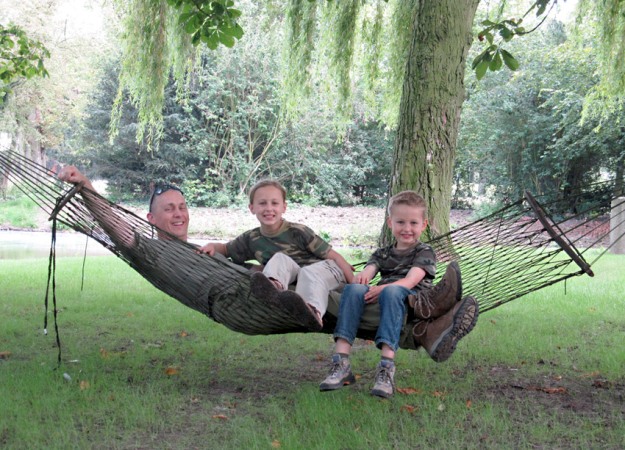
Figure 14 - The Finished Hammock

Figure 14 - The Finished Hammock


Woodlore would like to thank John van Zanen for all of his hard work in putting this extensive guide together. You can expect more from this contributor in the future…

To everyone out there who has used this guide to make your own hammock, please let us know how you got on, and send us a photo to show where your hammock ended up!

Nick Simmons re-scales his WK1 Woodlore Knife

Back in August of this year, we posted some photos on our blog of a Julius Pettersson knife, which Woodlore customer Nick Simmons had made a handle for. Shortly after this, Nick got in touch with us again to share some photos of his original WK1 Woodlore Knife, which, after years of use, he decided to re-scale.

When asked if he’d mind us posting the pictures on our blog, he replied, “Yes, but I fear the puritans will hunt me down and lynch me for changing it!” Well, there’s only one way to find out! Let us know what you think of Nick’s handiwork:

Hi there,

I had some fun over the past few days re-scaling my Woodlore Knife. The original maple had stained over the years, so I decided to have a change:

Nick's re-scaled WK1 Woodlore Knife

Nick's re-scaled WK1 Woodlore Knife

Continue reading

How to make your own Hammock – Part 3

<< Read Part 2 <<


Part 3:


Now that you have finished the hard work of making all those knots, you are ready for the finishing and final constructing of your hammock. At this time you will probably be able to make a Sheet Bend knot blindfolded. I have several hammocks knotted using sisal rope, but sisal really is murder on your hands. In the past I have worked with sisal until my hands were sore and blistering. So it was about time to try to make a hammock of green paracord. This makes life more easier. There is always a great sense of relief when you finally finish the net of the hammock. A milestone so to speak.

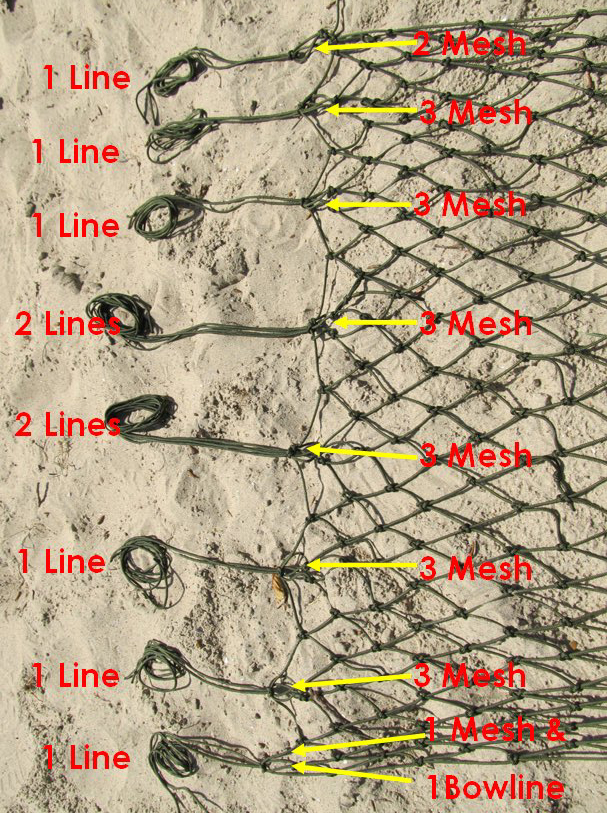
Now, cut 20 pieces of rope of 220 centimetres; these ropes you will be doubled and will be attached to the ends of the mesh of your hammock, acting as guy wires. Use two double wires for the middle two guy wires. This is because most of the force will be put to those wires. Figure 8 shows the mesh you need to take to attach the wires to.

Figure 8 - Lines & Mesh

Figure 8 – Lines & Mesh

Continue reading

Craig Turner’s Julius Pettersson Knife

The following post was kindly provided by Woodlore customer Craig Turner:

Dear Ray Mears and Woodlore team,

First and foremost I would like to thank you for the enlightment over the years on the many people, places and the knowledge that you hold. Alongside forgotten pioneering explorers, you have also brought wonderful craftsman to the forefront of my attention. Thank you.

The raw materials

The raw materials

Continue reading

How to make your own Hammock – Part 2

<< Read Part 1 <<


Part 2:


Make a small Bowline Knot in the first piece of rope and put the loop around the nail in cross B. Zigzag the rope loosely around the nails of the first and second row. When you reach the last nail in the first row, put the rope around the last nail in the third row and turn to the last nail of the second row to make your first knot (see Figure 3A & 3B).

Figure 3A - The Start

Figure 3A - The Start


Figure 3B - The First Knot

Figure 3B - The First Knot

Continue reading

How to make your own Hammock – Part 1

Over the coming weeks, we will be releasing a four-part guide on how to make your very own hammock using para cord. This excellent step-by-step tutorial was very kindly supplied by Woodlorean John van Zanen of the Netherlands; thank you!

We’ve split the guide into four different sections, allowing you to have a go at each stage before the next set of instructions is released. Today we have Part 1; we hope you enjoy this guide and would love to hear from anyone that gives it a go.


Part 1:

It is always very rewarding to make your own kit. When I finished the Camp Craft course at Woodlore I decided to make a hammock. I learnt making a hammock using this technique when I was a boy scout and it was quite a long time ago since I had made my last one. But when you are living in a fixed camp a hammock is a useful item. It not only gives you a place to sleep at night but also a place to sit during the day and it adds comfort to the times you spend outdoors.

This is an easy technique and you don’t have to be a knots expert to try to make this sort of hammock. So during the construction of my latest project this summer I took some pictures while I was working and translated the instructions they gave me as a boy scout into English. I hope this guide will inspire my fellow Woodloreans to make their own project. Good luck.


What do you need?

  • Sisal rope, two wire, about 1 kilo (when using paracord you will need about 230 meters depending on the length of the hammock)
  • Two pieces of wood from 2.6 cm by 1.8 cm by 70 cm long (or just two pieces of wood from nature)
  • Two steel rings (optional)
  • A shelf or board of about 24 to 110 cm
  • Sixty-six nails of 6.5 cm
  • Stick or broomstick of about 120 cm
  • Tape


Preparing your work board:

Draw the pattern in figure 1 on the shelf and hit the nails into the board at the spots marked with the dots. Remove the heads from the nails with a pair of pliers. Also, drive a nail in the board at the site of cross B. The nails have to stick about 4 cm out of the board. Be careful for nails that protrude below the shelf! Treat the top of the nails with a file and sandpaper and remove the sharp edges to save your hands and your rope.


Figure 1A - The Pattern

Figure 1A – The Pattern

Continue reading

Customer review: The Honey Stove

The following kit review was very kindly sent in by Woodlore customer Julian who, we’d like to point out, is not affiliated with Woodlore in any way – he’s just a very happy customer!

Dear Woodlore,

Yesterday I just used the Honey Stove, and I must say what an amazing piece of kit it is. The crusader cup and stand don’t even compare.

Julian's Honey Stove being put to the test

Julian’s Honey Stove being put to the test

Continue reading

Hans Hilverdink’s Julius Pettersson Knife

The following post was kindly sent in by Woodlore customer Hans Hilverdink from the Netherlands; another beautiful example of the type of handle that can be made:

Hello Woodlore,

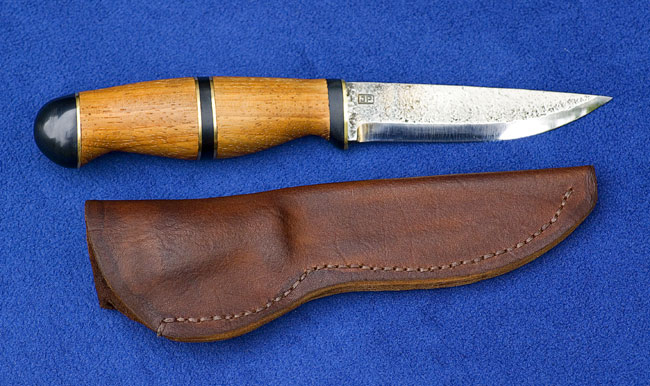
I’ve made myself a knife, using the blade of Julius Pettersson. I ordered some tools and stuff from Finland. It’s made of unknown tropical hardwood, brass and black nylon; all found in the shed of my father:

Hans' Julius Pettersson Knife complete with leather belt sheath
Hans’ Julius Pettersson Knife complete with leather belt sheath

It was good fun and I will be making more of this. I found myself a new hobby!

Thanks, with kind regards,

Hans Hilverdink,
The Netherlands