Tag Archives: bushcraft

Can You Match the Deer Species?

The following post was written by Woodlore Senior Assistant Ross Burt:

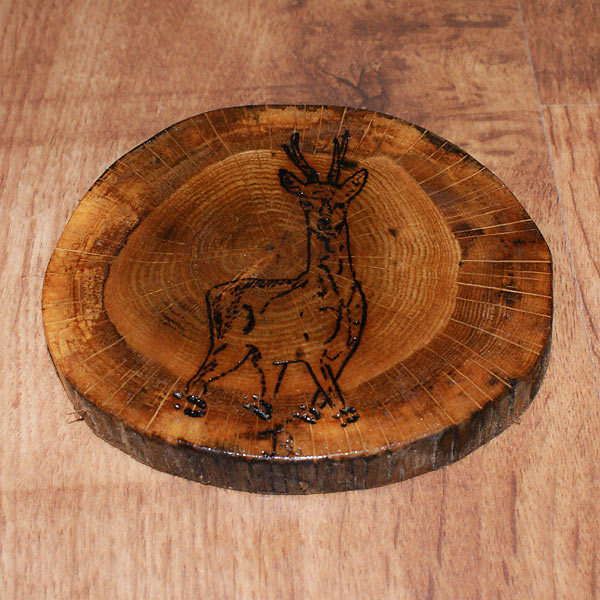
During the year and especially the winter months I produce my artwork to sell; I call this my ‘Bush Art’. During a Fundamental Bushcraft course on which Tom and I were working, a large beech tree fell and landed on a yew tree. One of the limbs that was smashed off was used by us to produce some coasters.

Some time later, I was sitting in a wood and it suddenly occurred to me that coasters usually come in a pack of six, now we have six species of deer in the UK! I popped out and used some beautiful oak for the ones shown below.

Ross Burt - Deer Coaster 4

Coaster #1

Continue reading

Richard Spencer Shares his Finished Knife Handles

It’s been a while since we shared any of your creations, so we thought we’d come back with a bang. Australian customer Richard Spencer displays not one, but two of his knife handles, made using the classic Hand Forged Knife Blade:

Dear Team,

What’s better than one of Julius Pettersson‘s blades? More than one! I am very lucky to have two of them:

A fine-looking pair of hand-finished knives

A fine-looking pair of hand-finished knives

The lower blade is set in the traditional way, with antler segments separated by some oiled birch in the middle and the tang hammered at the end. This was great fun, but it is possible to avoid all the filing and drilling – start haunting second-hand market stalls…

I found the top handle in a car boot sale. The blade to which it belonged had rusted very badly and it took almost no effort to remove the old corroded loose tang and so rescue the horn, alloy and some of the leather segments.

There’s a section of epoxy putty behind the guard to get the spacing right and there was a very large hole in the horn handle, so the Pettersson tang had to be set in epoxy, but it is rock solid. The nicest thing being that the old handle has been given new purpose.

Very best wishes to all of you!

Richard Spencer,

Northam, Western Australia

The Joy of Carving

The following post was written by Senior Assistant Mark Booton:

I am, if I’m being entirely honest, not a natural when it comes to carving. It is one of those Bushcraft skills which I need to work on. The fact that I find it challenging strengthens rather than diminishes my will to improve, and also heightens the enjoyment and satisfaction I feel when I carve something that I can be proud of.

I put down my knife and finish sanding my second Kuksa, a traditional wooden cup crafted by the Sami people of northern Scandinavia (my first attempt didn’t quite turn out as planned – my wife now very kindly refers to it as the ‘olive dish’!). I can remember the pride with which I took home my first carved spoon after attending the Fundamental Bushcraft course back in 2010. The fact that the spoon was not very good (misshapen and not symmetrical!) didn’t matter. I had toiled over it, sweated and bled (a little!), and eventually after several hours of sawing, carving and last-minute sanding produced something that, for all intents and purposes, resembled an eating implement… okay then, a spoon!

A traditional Swedish Kuksa cup

A Kuksa cup carved by Woodlore Senior Assistant Mark Booton

Continue reading

Fitness isn’t Just for Gym Bunnies

Woodlore Senior Assistant David Southey, trekking near the Devil's Kitchen in Snowdonia

Woodlore Senior Assistant David Southey, trekking near the Devil’s Kitchen in Snowdonia

You’ve skied a full day, flattened out a platform, set up your camp and set off to find, fell, retrieve and process your firewood for the night. Sat in your warm tent drinking a brew, you look over your route for tomorrow, then tea and bed, waking when it’s your shift to stoke the stove.

Fitness enables mental alertness, the capability to make quick decisions, problem solving skills and the ability to cope with fatigue. Physical robustness isn’t just about being the fastest or strongest; it’s one of the keys to the backcountry. Being able to carry out demanding tasks with ease means you’re less likely to make a simple mistake which could have serious consequences for you and those in your charge. Continue reading

Time for Change: My Experience of the Fundamental Bushcraft Course

The following post was written by Woodlore’s Quartermaster and Aspirant Instructor Keith Whitehead:

I’m sometimes asked during the winter months if things at Woodlore are quiet. Nothing could be further from the truth. It’s true that our UK season has wound down following the end of the Journeyman Course, but there is still work to do and adventure to plan.

Keith Whitehead, working a deer hide during the Journeyman course

Keith Whitehead, working a deer hide during the Journeyman course

One of my first tasks as Quartermaster is to organise the course equipment so that it is ready for the next season. This, as you might imagine, takes some time and, sometimes, during the process of organising and sorting through the stores, I come across a lost gem that sparks the imagination. One such gem is an old catapult. When I first set eyes on it, there was a glimmer of a memory from years ago and I recognised it as being the same item pictured in The Survival Handbook, written by Raymond Mears in 1990. I received the book as a present soon after its publication and was immediately enthralled by it. This was to be one of the stepping-stones that led me to Woodlore and started my journey with the company. Continue reading

Navigation – The Key to the Wilderness

The following post was written by Woodlore Aspirant Instructor Rob Bashford:

The Art of Navigation

I have often heard Ray refer to the compass as the ‘key to the wilderness’. By this I believe he means it unlocks the full potential of the outdoors, enabling you to travel confidently in wild places. Navigation is undoubtedly one of those foundation skills, along with the likes of first aid, around which all other bushcraft skills should be built. The ability to navigate proficiently is an absolutely key skill if you plan to venture into the outdoors and its importance rises in direct proportion to the remoteness of the environment. It is very often the case that emergencies in the outdoors are the end result of an earlier navigational error.

The problem is that in today’s world of GPS and mapping software, now conveniently incorporated into smart phones, it is all too easy to think that the map and compass have become outdated. Nothing could be further from the truth. As in other areas of bushcraft, the best tools are those that are simple and robust, meaning they can be relied upon in tough environments. Those that utilise electronics and batteries do not generally fall into this category. That is not to say there is no place for this technology but it should never be the sole means of navigation. There is no substitute for the humble map and compass.

The ability to navigate with confidence is a wonderfully liberating skill, enabling you to venture further off the beaten track and really immerse yourself in wild places. The real beauty of this skill is that it is entirely transferrable to different environments. Yes, the maps may look a little different in foreign countries and there are some important variables to be aware of, but ultimately the skill of using a map and compass remains the same wherever you are in the world.
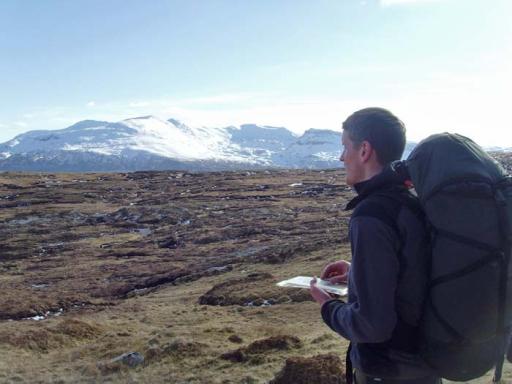
Rob Bashford navigating in the hills of Scotland

Rob Bashford navigating in the hills of Scotland

In its simplest form, navigation means knowing how far you have travelled from a known point and in what direction, a process known officially as ‘dead reckoning’. In reality there is a bit more to it than this and like many of the skills in bushcraft, observation is paramount. Learning to read the subtleties of the terrain allows you to venture into seemingly featureless landscapes, where there are no signs or paths to guide you. It also builds an inner confidence and that frees you to visit those less frequented places.

Although there is certainly scope for teaching yourself the basics of navigation, as when learning most new skills, a little instruction goes a long way. Woodlore has been running wilderness navigation courses for some years now and we have distilled Ray’s many years of wilderness navigation experience into a readily digestible format. These courses are unique, in that we teach you techniques you can use anywhere in the world, with a strong emphasis on woodland navigation. This environment mirrors the rigours of navigating in reduced visibility and is perfect preparation for the night navigation elements of the course. It is safe to say that when you can find your way confidently through dense forest at night, with only a map and compass to guide you, you can navigate just about anywhere.

– Rob Bashford